
Pakistan Motorway Speed Limits 2026: Rules, Fines & Driver's Guide
Current NHMP motorway speed limits, practical road-safety guidance, and where to check official travel alerts before leaving.
Quick Summary
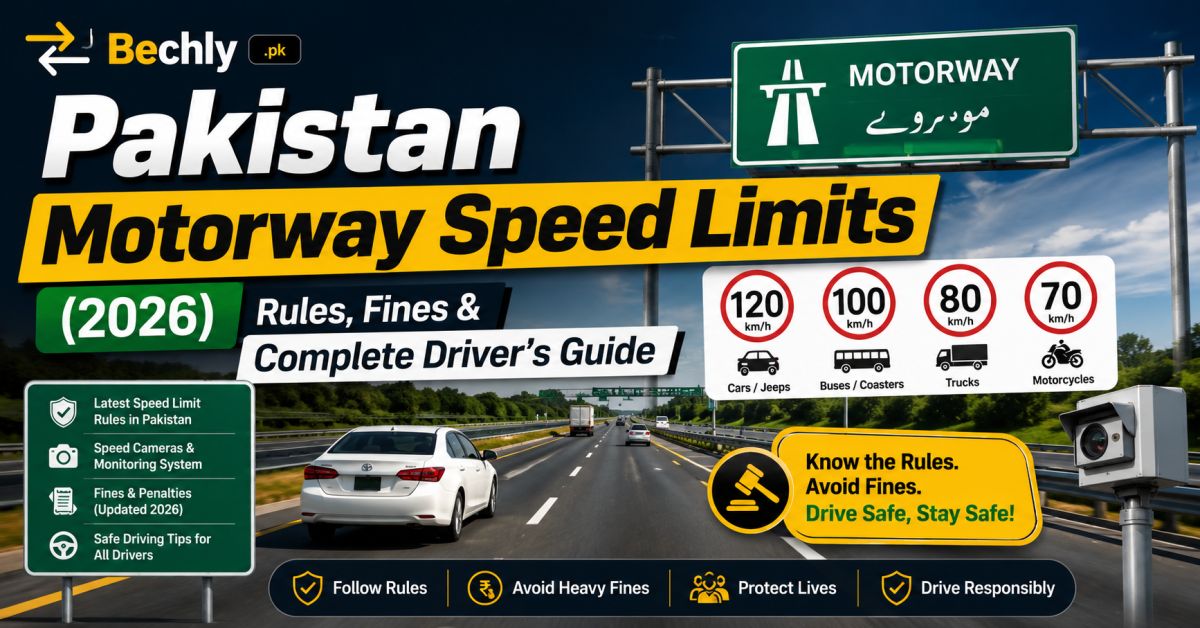
- Current motorway limit: 120 km/h for cars/LTVs, 110 km/h for buses and heavy vehicles.
- The March 2026 reduction to 100 km/h was withdrawn; 120 is back nationwide.
- IslamabadÔÇôLahore (M-2): 120 km/h, most heavily patrolled route.
Table of Contents
Update (31 August 2026): Motorway speed limits are 120 km/h for cars/LTVs and 110 km/h for HTVs/PSVs and remain in effect nationwide. The March 2026 fuel-saving reduction to 100 km/h was challenged in the Islamabad High Court and then formally withdrawn by the government via an NHMP notification; no further reduction has been reintroduced. Driving above 150 km/h now carries a fine plus an FIR and a motorway ban.
Last week on the M-2, I saw a driver get fined for not knowing the new speed limit
I was coming back from Islamabad to Lahore, cruising at 110 on the M-2, when I saw a white Corolla pulled over by Motorway Police. The driver was arguing with the officer — he genuinely thought the speed limit was still 100 km/h. The officer handed him a challan for Rs. 2,500. That moment made me realize: with all the back-and-forth on speed limits lately, a lot of drivers are confused. So let me break down exactly what the rules are right now in June 2026.
Current Speed Limits on Motorways and Highways (June 2026)
Here's the big news: the government has restored the previous speed limits on motorways and national highways after temporarily reducing them as fuel-saving measures during the Middle East conflict . The restoration happened on June 21-22, 2026 .
Motorway Speed Limits (Restored)
Cars and Light Transport Vehicles (LTVs): 120 km/h
Public Service Vehicles (PSVs) and Heavy Transport Vehicles (HTVs): 110 km/h
National Highway Speed Limits (Restored)
Cars and LTVs: 100 km/h
PSVs and HTVs: 80 km/h
According to the National Highways and Motorway Police (NHMP) spokesperson, these restored limits apply only on road sections where those limits were previously in force . The lower limits of 90 km/h and 60 km/h on certain sections remain unchanged .
Tip: If you're driving from Lahore to Islamabad on the M-2, the 120 km/h limit is now back. But don't get too comfortable — enforcement is strict, and the speed cameras are always watching. I've seen people fined for doing just 125. Keep it at 115-118 to be safe.Why Did the Speed Limits Change?
Here's the full story. In March 2026, the government reduced speed limits as part of a fuel conservation campaign . The global fuel crisis, triggered by the Middle East conflict, had disrupted energy supplies . The limits were cut: cars from 120 to 100 km/h on motorways, and heavy vehicles from 110 to 90 km/h .
But then, things changed. The Islamabad High Court declared the government's speed reduction decision illegal, stating there was no legal provision to reduce speed limits for fuel savings . The court ordered the NHMP to refund all fines collected since March 26 . Shortly after, the government officially restored the previous limits .
"The restoration of speed limits does not mean road safety rules have been relaxed," — NHMP officials warned, urging motorists to drive responsibly and remain within the prescribed limits .
Fines and Penalties for Speeding on Motorways
When the reduced limits were first enforced in March 2026, the Motorway Police started issuing fines on the M-2 for violations. A motorist was fined Rs. 2,500 for driving at 115 km/h under the revised regulations .
Since then, over 58,000 vehicles were fined for violating the speed limits during the temporary reduction period . Now that the limits are restored, the same fine structure applies — but the thresholds have moved back to 120 km/h for cars.
Warning: Don't think you can get away with speeding because the limits are higher now. I've seen Motorway Police set up speed traps on the M-2 near Bhera and on the M-1 near Rashaki. They use laser guns and cameras. If you're caught doing over 130, expect a challan of at least Rs. 2,500-5,000. And if you're really reckless, they can impound your vehicle.How to Pay Your Motorway Challan — New Raast QR System
The NHMP has made paying fines much easier. They've launched a Raast QR-based payment system for e-challans in partnership with Zindigi by JS Bank .
Here's how it works:
When you get a speeding fine, your e-challan will have a Raast QR code printed on it.
Open any mobile banking app that supports Raast QR (most Pakistani banks do now).
Scan the QR code — the payment details will auto-fill.
Confirm the payment — it processes instantly.
Currently, this system is active on the M-1 (Islamabad-Peshawar), M-2 (Islamabad-Lahore), and the Islamabad-Murree Expressway . The government plans to expand it to all motorways if the pilot is successful. You can also call the NHMP helpline at 130 or reach out on social media for complaint resolution .
Note: The Raast QR system is part of the government's Cashless Pakistan vision. If you're a regular motorway driver, save a few minutes by using this instead of waiting in line at the police station. Just don't get fined in the first place!Key Motorway Routes and Their Speed Limits
Here's a quick reference for the major motorways in Pakistan:
M-1 (Peshawar-Islamabad): Cars 120 km/h, HTVs 110 km/h. The NHMP has beats from Peshawar to Rashaki (KM-502 to KM-459) and Rashaki to Sawabi (KM-459 to KM-420) .
M-2 (Islamabad-Lahore): Cars 120 km/h, HTVs 110 km/h. This is Pakistan's busiest motorway — and the most heavily patrolled. The NHMP has enforcement beats from Balkasar to Lilla (KM-266 to KM-213) and Lilla to Kot Momin (KM-213 to KM-162) .
M-4 (Pindi Bhattian-Multan): Cars 120 km/h, HTVs 110 km/h. NHMP beats from Gojra to Abdul Hakeem (KM-58 to KM-142) .
M-5 (Multan-Sukkur): Cars 120 km/h, HTVs 110 km/h. NHMP beats from Uch Sharif to U-Turn (KM-579 to KM-680) .
M-14 (Hakla-Daud Khel): Cars 120 km/h, HTVs 110 km/h .
If you're selling your old car to buy something more fuel-efficient for motorway driving, check today's used car listings on Bechly.pk — I've found some great deals on Corollas and Civics that are perfect for long drives.
Safe Driving Tips for Motorways in 2026
Based on my experience driving the M-2 and M-1 for years, here's what I've learned:
Keep your speed at 115 km/h max. Even though the limit is 120, speed cameras have a tolerance of about 5 km/h. Going at 118 won't get you fined, but 125 will.
Use the left lane only for overtaking. This is a rule, but nobody follows it. Still, if you're driving slow in the left lane, you'll get flashed by faster cars — and the police might pull you over for lane discipline.
Check your tires before a long trip. Motorway speeds are no joke. A tire blowout at 120 km/h is dangerous. I always get my tires checked at a pump near the motorway entrance.
Keep your headlights on, even during the day. It's not mandatory, but it makes you visible to other drivers. I've seen too many accidents because a grey car blended into the asphalt.
Don't use your phone while driving. The NHMP is cracking down on distracted driving. I saw a guy get fined for using WhatsApp while driving on the M-2 last month.
If you're looking to buy a used car that's reliable for motorway driving, browse used cars for sale on Bechly.pk — you'll find plenty of options from genuine sellers in Lahore, Islamabad, and Karachi.
Frequently Asked Questions
What is the current speed limit on M-2 motorway in 2026?
The current speed limit on the M-2 motorway for cars and light vehicles is 120 km/h. For heavy vehicles and passenger buses, it's 110 km/h. These limits were restored in June 2026 after being temporarily reduced to 100 km/h for cars .
How much is the fine for speeding on Pakistan motorways?
Speeding fines start at around Rs. 2,500. During the temporary reduction period, a driver was fined Rs. 2,500 for doing 115 km/h . Fines can go higher depending on how much you exceed the limit. If you're caught doing 140+, expect a challan of Rs. 5,000 or more.
Can I pay my motorway challan online in Pakistan?
Yes. The NHMP has launched a Raast QR-based payment system for e-challans on the M-1, M-2, and Islamabad-Murree Expressway. You can scan the QR code on your challan using any mobile banking app and pay instantly . You can also call the NHMP helpline at 130 for assistance .
Why did the government reduce motorway speed limits in 2026?
The government reduced speed limits in March 2026 as a fuel-saving measure during the global fuel crisis caused by the Middle East conflict . Cars were limited to 100 km/h and heavy vehicles to 90 km/h. The Islamabad High Court later declared this reduction illegal, and the government restored the previous limits in June 2026 .
What is the speed limit for trucks and buses on motorways?
For public service vehicles (buses) and heavy transport vehicles (trucks, trailers), the speed limit on motorways is 110 km/h. On national highways, it's 80 km/h .
What is the Islamabad to Lahore motorway speed limit?
On the M-2 (Islamabad–Lahore) the limit is 120 km/h for cars and light vehicles and 110 km/h for buses and heavy vehicles, the same as most of the motorway network. The M-2 is Pakistan’s most heavily patrolled motorway, so keep it around 115–118 km/h to stay clear of camera tolerance.
What is the current motorway speed limit in Pakistan (2026)?
As of September 2026 it is 120 km/h for cars/LTVs and 110 km/h for HTVs/PSVs. The March 2026 cut to 100 km/h was withdrawn. Some sections carry lower posted limits (90 or 60 km/h) that were never changed.

Bechly.pk Editorial Team
Based in Lahore, Pakistan · Covering classifieds, buying & selling since 2025
Pakistan's trusted buy and sell marketplace. We write practical guides to help buyers and sellers compare options, avoid common mistakes, and make better local decisions.